
Camions Sentinelles
Intelligent Mobile Sensor Fleet
40 waste collection trucks transformed into a territorial data infrastructure — covering every road in the Province of Namur, every week, without a single extra kilometer driven.
A hundred trucks driving every road in Namur — and generating no data.
The BEP's waste collection fleet covers the entire Province of Namur one to two times per week — a hundred trucks driving hundreds of kilometers of road every day, year-round. For a long time, this represented an untapped operational asset: the trucks were already moving through every corner of the territory, but the journeys generated no data beyond waste collection records.
At a time when territorial knowledge is increasingly central to public service decision-making, the question became unavoidable: what could those daily routes tell us, if the trucks were equipped to listen? The trigger was a Walloon Region "Territoire Connecté" call for projects — BEP's response won a Smart Region Award in 2019 and secured 50% public co-financing, for a total project value of €500,000.
What could those daily routes tell us, if the trucks were equipped to listen?
A platform architecture, not a device. Built to outlast every campaign it runs.
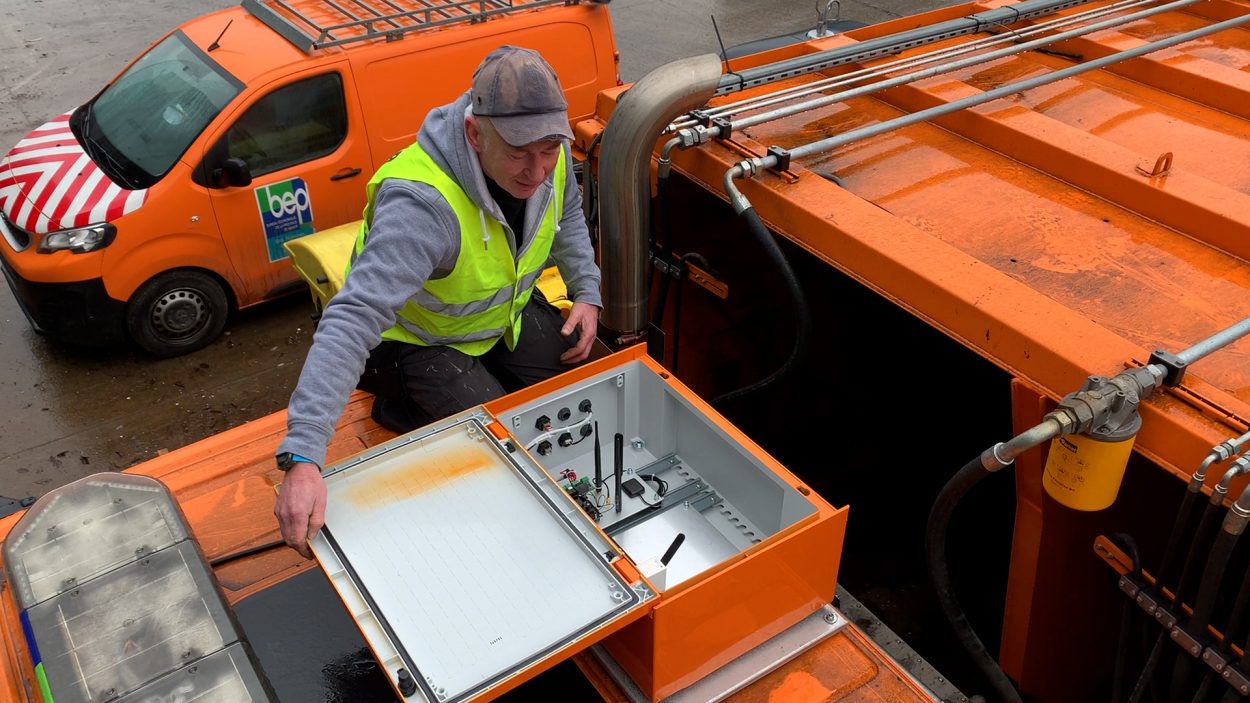
Thelis designed and built the sensor hub installed on each truck — a self-contained embedded system housing a custom electronics board, local storage, connectivity modules, and data transmission hardware, powered directly from the vehicle. The initial mission was to map 2G/3G/4G coverage across the province. Thelis proposed going further: equipping the fleet with NVIDIA Jetson processors — technically overspecified for the immediate need, but opening the door to AI-capable edge computing on every truck.
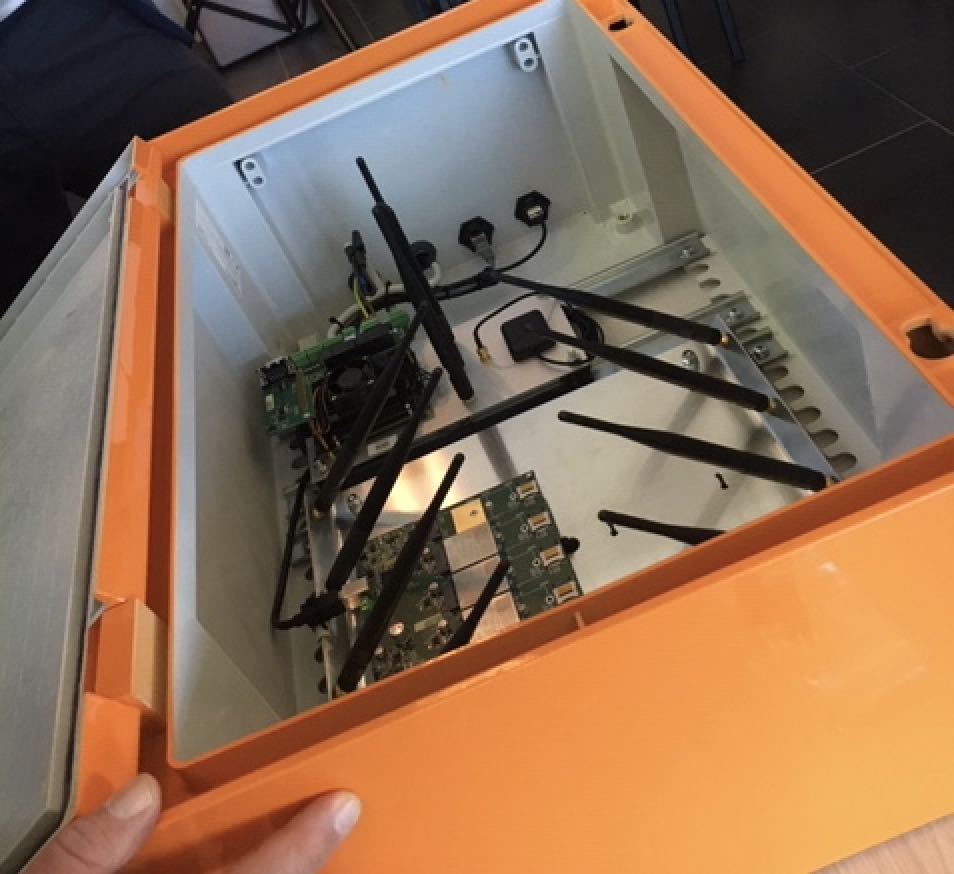
Multi-campaign platform
Any sensor campaign can be configured and deployed across the fleet — air quality, electromagnetic emissions, road surface condition, remote meter readings, infrastructure monitoring — without touching the hardware.
NVIDIA Jetson edge AI
Intentionally overspecified for the first campaign — the Jetson enables on-board AI inference, real-time data preprocessing, and a platform lifespan measured in years rather than months. A deliberate investment in future capability.
Adaptive transmission logic
Up to one month of local on-board storage. Transmission frequency, local retention, and processing priority reconfigurable per campaign — accounting for data urgency and available network coverage in the field.
Open IoT cloud platform
Built alongside the hardware from day one — designed to ingest data from multiple sources and become a central operational and environmental intelligence layer for BEP, its partners, and the Namur territory.
40 trucks. A live territorial data infrastructure. Two awards.
40 trucks equipped and operational across the Province of Namur, with an additional unit deployed in the Province of Luxembourg for reproducibility testing with IDELUX. The project was awarded the Transport & Logistics Award 2022 — barely months after deployment. Smart Region Award 2019 at project selection.
Beyond the awards: a live territorial data infrastructure that did not exist before, covering every road in Namur on a weekly basis, and a platform ready to host future sensor campaigns — air quality, road surface, infrastructure monitoring — without any hardware changes.
Key Challenges
Designing for campaigns, not use cases
The hardest architectural decision was building a system with no fixed purpose beyond the first one. A sensor hub for 4G mapping is a simple device. A sensor hub that can run AI inference, store a month of data, adapt its transmission frequency to network availability, and host any future campaign without hardware modification — that is a platform. Making that distinction early, and convincing the client to invest in the larger vision, shaped every subsequent engineering decision.
Edge intelligence in a vehicle environment
Trucks are harsh environments for electronics — vibration, temperature variation, variable power supply, intermittent connectivity. Designing a system reliable enough to run unattended across a fleet of 40 vehicles, in zones where cellular coverage is precisely what is being measured (and therefore cannot be assumed), required careful attention to local buffering, watchdog logic, and graceful degradation when transmission is impossible.
Transmission strategy as a design variable
Different data types have fundamentally different urgency profiles. Road surface data can wait for a nightly batch upload. A gas leak sensor would require near-real-time transmission. Building a system where transmission frequency, local retention, and processing priority can be reconfigured per campaign — without touching the hardware — was a core engineering requirement, not an afterthought.
Proactive scope expansion as engineering responsibility
The NVIDIA Jetson recommendation was not in the brief. It added cost — modest, but real — and required justification. Thelis made the case that the incremental investment unlocked a qualitatively different capability: on-board AI processing, multi-campaign flexibility, and a platform lifespan measured in years rather than months. This kind of proactive thinking, grounded in a clear view of what the technology makes possible, is what distinguishes engineering from execution.