
Zharis
The power of a cloud — on your own infrastructure.
A rackable hardware appliance that runs performant large language models locally. Cloud-class AI compute in a single rack unit — installed in your datacenter, governed by you, with your data never leaving your walls.
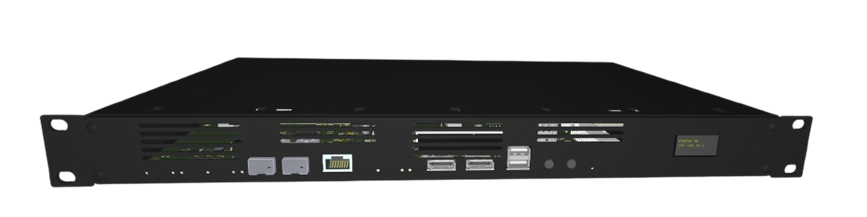
A rackable box that puts AI inside your walls.
Zharis is hardware — a self-contained AI compute appliance you slot into your rack like any other server. It runs large language models locally so your organisation gets cloud-class AI without sending a single byte to a third party.
Rackable hardware
A single 1U unit engineered to mount in a standard 19" rack — the AI appliance is the product, not a cloud subscription.
Runs LLMs locally
Performant language models execute on the appliance itself — assistants, RAG, analysis and automation, with no API call leaving your network.
Your data stays in
Every prompt, document and inference stays inside your infrastructure — sovereignty and compliance by architecture, not by policy.
Cloud-class power
The compute density and bandwidth of a cloud node — a 10 Gb/s I/O fabric and dedicated AI acceleration — in a footprint you own and operate.
Engineered end-to-end by Thelis — born from the ReconnAIssance research program.
Under the hood.
Configurations
Run any of the well-known open models locally — from Gemma on the NVIDIA Jetson AGX Orin, up to GPT-OSS-120B on the NVIDIA Jetson AGX Thor. The more unified memory, the larger the model you can serve.
Form factor & mechanical
Compute
Memory & storage
Network & I/O
Power & thermal
AI & software
Compliance
Final specifications confirmed per deployment. Contact us for the full datasheet.
Real AI workloads, entirely local.
Private assistants
Internal copilots and chat assistants grounded in your own knowledge — available to your teams without exposing anything to a public model.
RAG over private documents
Retrieval-augmented generation across your confidential corpus — contracts, records, archives — searchable and queryable, on-premises.
Document & data analysis
Summarisation, extraction, classification and structuring of large document sets — turning unstructured data into usable signal.
Workflow automation
Embed local inference into your processes — triage, routing, generation and decision support — without a recurring per-token cloud bill.
The AI you need, without the exposure.
Data sovereignty
GDPR, NIS2 and sector-specific compliance from day one. No data transmitted externally — your regulatory posture stays clean and auditable.
Deterministic latency
No network round-trips, no shared-infrastructure contention. Inference happens locally, at consistent speed — independent of external conditions.
Total control
You choose the models, set the access rules and own the update schedule. No vendor lock-in, no surprise pricing — the system evolves as you decide.
Rack it. Connect it. Call the API.
Rack
Mount the 1U appliance in your existing rack and power it on — no datacenter overhaul, no specialised infrastructure required.
Connect
Attach it to your private network. Everything runs inside your perimeter — the appliance never needs outbound internet access to operate.
Integrate
Point your applications at the local API and start serving inference. It slots into your stack like any internal service.
Want it deployed, audited and maintained for you?
Zharis runs perfectly on its own. If you would rather have Thelis handle implementation, quarterly audits and ongoing maintenance, the Local AI Bundle wraps the appliance in a complete managed engagement.
See Zharis run AI
inside your walls.
Tell us about your infrastructure and your AI use case, and we will set up a live demonstration of the appliance running your kind of workload — on-premises.