
Kando
Care Home Hardware Ecosystem
From innovation workshops to manufactured product — Thelis co-engineered the full hardware stack of a care home assistant platform now active in nursing homes across Belgium, developed entirely in-country with zero installation works required.
Nursing homes run on paper, clipboards, and outdated tools.
Care staff spend a disproportionate share of their time on administrative tasks — documenting care, managing medication reminders, coordinating between teams, responding to resident calls — at the expense of the time they could spend with residents. Meanwhile, the regulatory and reporting burden on care institutions keeps growing.
Kando's founders — a care home director with 35 years of sector experience and an entrepreneur with a decade in the industry — had a precise diagnosis of the problem and a clear vision of what a solution should look like. What they needed was an engineering partner capable of turning that vision into a real product: hardware that could live in a care home room, be operated by caregivers with no technical training, and reliably handle voice interaction, biometric data, emergency calls, and care documentation simultaneously.
What they needed was an engineering partner capable of turning that vision into a real product — before there was a product, before there were specifications.
A two-product architecture built from the ground up — before there were specs.
Thelis joined Kando from day one. The engagement started with structured innovation workshops and architecture sessions, working alongside the founders to define what the product actually needed to be: what form factors made sense, how the ecosystem should be structured, where the intelligence should live, and what constraints a care home environment imposed on every design decision.
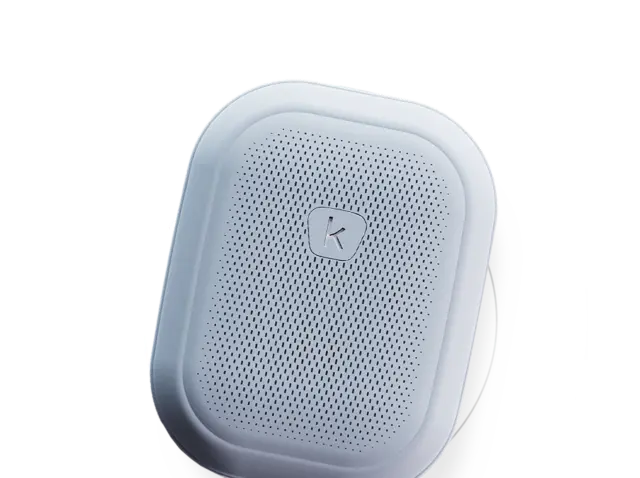
Kando Box
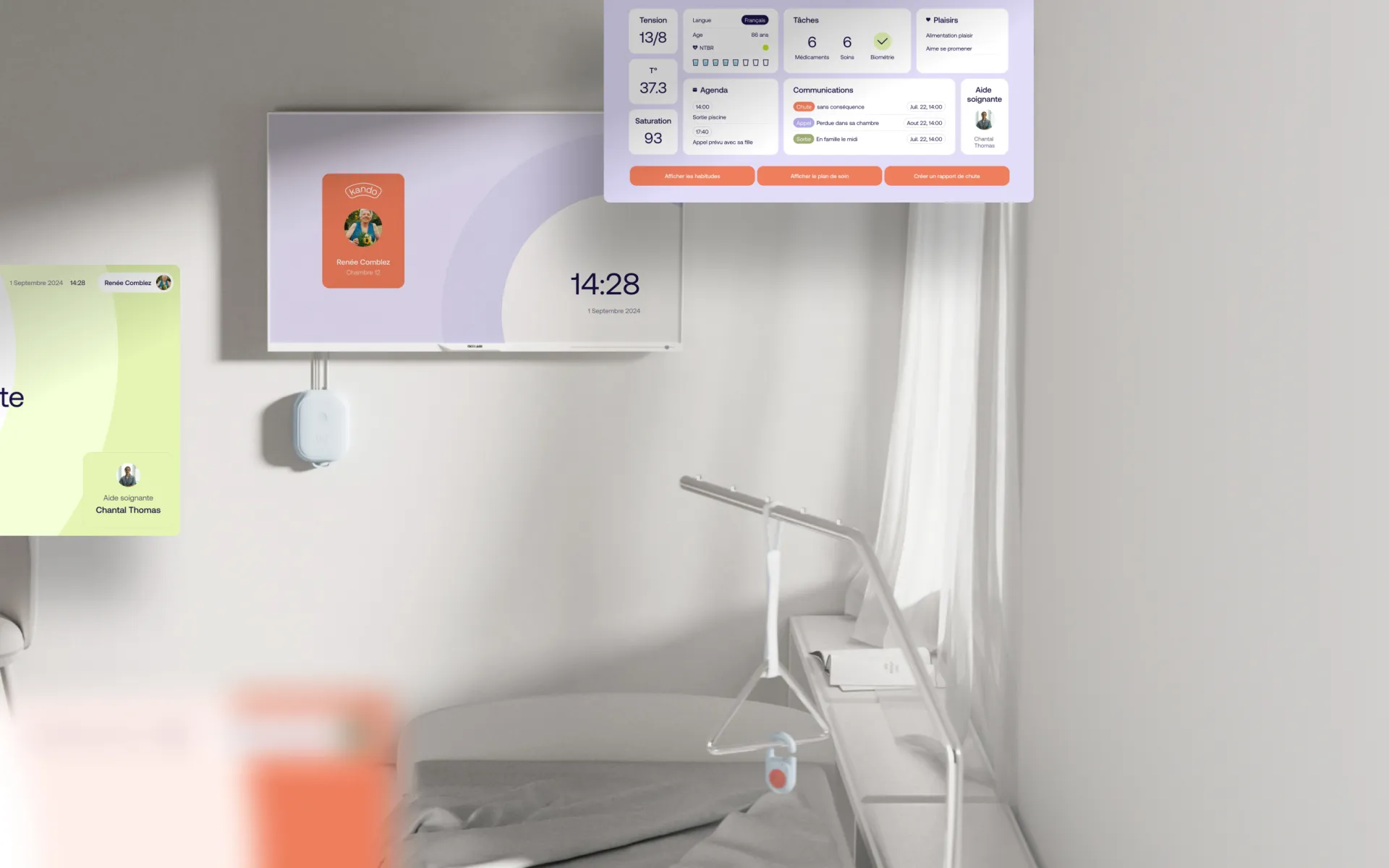
A discreet wall-mounted device connecting via HDMI to any television. Handles voice interaction, care display, biometric data integration, and RFID caregiver identification — all in a single enclosure requiring zero installation works.

Kando Smart Button
A next-generation nurse call device with bi-directional communication, haptic feedback, NFC identification, water resistance, and integrated battery with dock-based charging. Operates independently for several hours without mains power.
Kando Space
The management software layer that ties the ecosystem together. Automates care documentation, coordinates team communication, prioritizes emergency calls, and generates regulatory reports — without requiring any technical expertise from staff.
Full hardware lifecycle
Thelis handles the complete stack: electronics design, firmware, enclosure engineering, and production supervision. The relationship that began as an innovation mission in 2022 has evolved into an ongoing hardware partnership as the product continues to develop.
A fully deployed care assistant ecosystem. Developed entirely in Belgium.
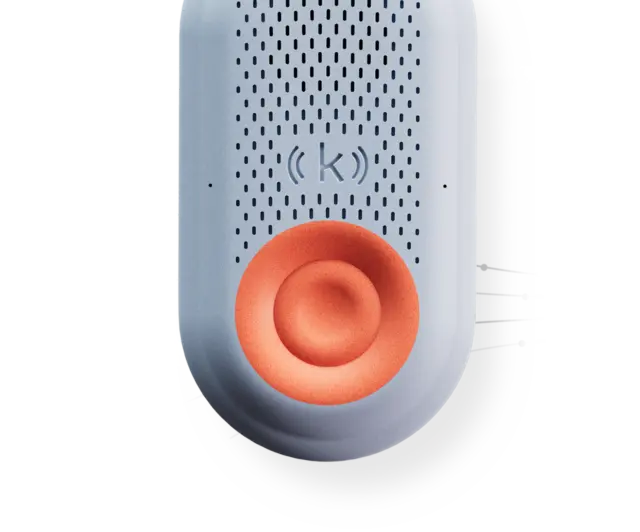
The Kando platform — Box, Smart Button, and Kando Space management software — is now active in nursing homes and continuing to expand. The ecosystem automates care documentation, coordinates team communication, prioritizes emergency calls, and generates regulatory reports without requiring any installation work or technical expertise from staff.
Developed entirely in Belgium. Three hardware products co-engineered from scratch. Both the Kando Box and the Smart Button operate independently for several hours during a power outage — a deliberate safety requirement, not an afterthought. The collaboration that began with a blank page in 2022 is an ongoing partnership.
What made this project demanding.
Building a product people will actually use
The hardest constraint in this project was not technical — it was human. A device deployed in a care home room has to be accepted by caregivers who didn't ask for new technology, operated by residents who may be cognitively or physically frail, and trusted by institutions that cannot afford failures. That means aesthetics, materials, and tactile quality are not cosmetic considerations — they are adoption determinants. Every enclosure decision, every surface finish, every button feel had to reconcile hardware engineering constraints with the lived experience of the end user.
From WiFi to DECT — questioning the obvious choice
The initial architecture relied on WiFi for device communication — the default assumption for any connected product. Field reality proved otherwise. WiFi in care home environments is unreliable: interference from other devices, inconsistent coverage across rooms, and the critical nature of nurse call communication made it an unacceptable foundation. Thelis identified the problem and drove the switch to DECT — a protocol designed precisely for reliable, low-latency voice and signaling in dense building environments. Recognizing that the obvious choice was the wrong choice, early enough to act on it, was a pivotal engineering decision.
Backup power as a safety requirement
A nurse call system that fails during a power outage is not a nurse call system. Integrating backup batteries into the Kando Box — within the constraints of a compact, wall-mounted enclosure with no installation works — required careful thermal management, battery sizing, and power architecture design. The Smart Button has its own integrated battery and dock-based charging. Both devices are designed to continue operating independently for several hours without mains power.
From idea to manufactured product
Thelis's role in this project spans the full hardware lifecycle — architecture, electronics design, firmware, enclosure engineering, and production. Managing that entire chain for a startup, where specifications evolve as the product encounters real users, demands a different kind of engineering discipline: staying rigorous enough to produce a reliable, certifiable device while remaining flexible enough to incorporate what the field teaches you.